
Grade-Appropriate Application
Method is chosen for the incline rather than habit. Controlling how much material sits on the surface at once is what stops it migrating downhill before it sets.
Serving Los Angeles, California & surrounding areas
Mon–Fri 8am–6pm Sat 9am–2pm
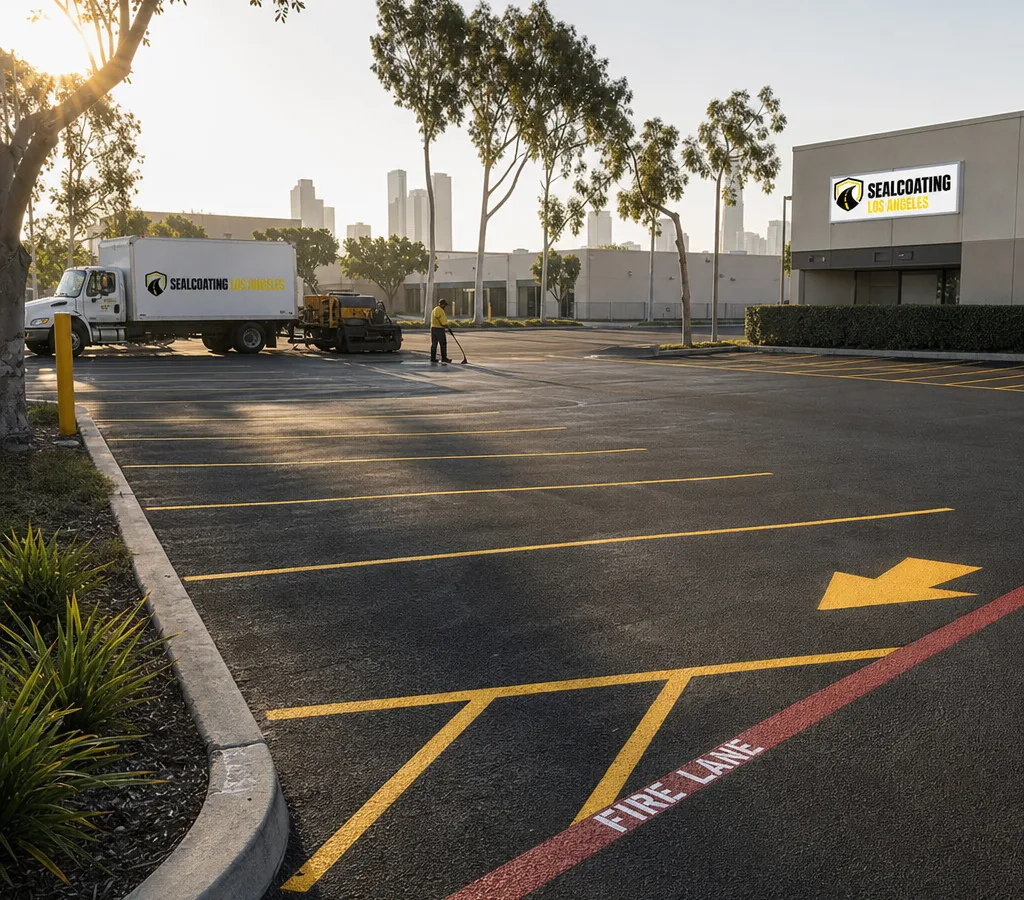
On a slope, sealer wants to move downhill and water wants to follow it. Application method, edge protection, and cure barricading all have to account for grade.
Pour the same material on flat ground and on an incline and you get two different results. Gravity pulls the sealer down the slope while it is still wet, which can thin the top of a driveway and build it up at the bottom if the application does not allow for it.
Water behaves the same way, only it keeps doing it for years. Run-off follows the fall line, concentrates at whatever the lowest confined point is, and works at the asphalt edge there harder than anywhere else on the surface. Those edges are usually where a sloped driveway starts to fail.
Both facts change the method rather than the material. How the coat is laid, which direction the work runs, where the edges need building up, and how the surface is protected while it cures are all decided by the grade in front of us.
A hillside walkthrough is as much about water as asphalt. We follow where it runs, where it stops, and what it has already done to the surface and its edges.
The second thing we are judging is working conditions. A steep surface changes how material can be applied and how the site has to be secured while it sets.
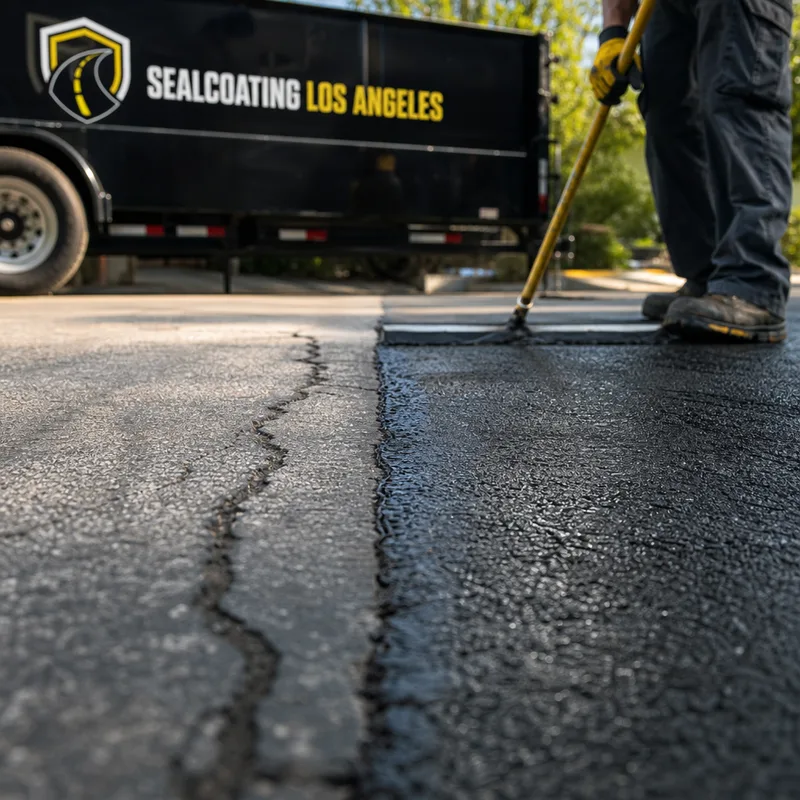
Each part of this work exists because the surface is not flat, from how material is laid to how the area is closed off while it sets.
Method is chosen for the incline rather than habit. Controlling how much material sits on the surface at once is what stops it migrating downhill before it sets.
The route water takes is identified and the edges along it are prepared properly. Treating the fall line as ordinary surface is how a sloped driveway fails from the sides inward.
An undermined edge is repaired, not coated. Where asphalt has lost support underneath, putting a finish over it only delays the day it breaks away.
The junctions at the top and bottom of a slope are cut and finished as their own detail, since both material and water collect at exactly those points.
A sloped surface needs securing differently while it cures. Barriers are set so nothing rolls, walks, or drains across a coat that has not set.
Before anything else we establish the fall line, the run-off route, and the low points. The whole plan follows from that.
Edges that have lost support are rebuilt first. There is no point coating asphalt that is about to break away at its weakest point.
The surface is cleaned with the slope in mind, since debris and wash water both travel downhill and will collect where we are about to work.
Material goes down in a way that keeps it where it is put, with the working direction and amount per pass set by how steep the surface is.
Barricades and markers go in so nothing crosses the surface during cure, and we tell you the window before the driveway is usable again.
Grade does not change the material, but it does change the labor, so a steep driveway sits higher in the range than a flat one of the same size. Residential work generally falls between $250 and $600, with larger or steeper driveways commonly $700 to $900.
Where edges have been undermined and need rebuilding, that is repair rather than protection and it is quoted separately: patching work starts near $2,500 and larger scopes reach $3,000 to $6,000 or more. Crack filling typically runs $350 to $1,500. We put the real number in writing after walking the slope.
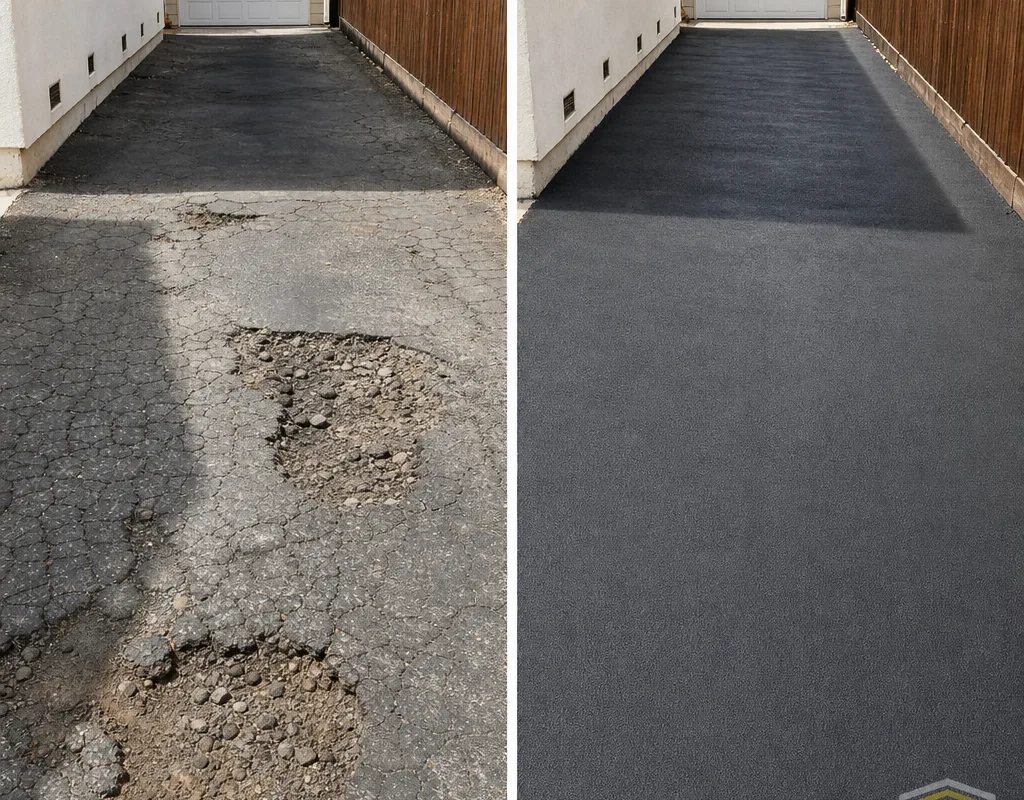
Book Your Free InspectionSurfaces after coating, the detail work where levels change, and how a site is held secure while a fresh coat sets.
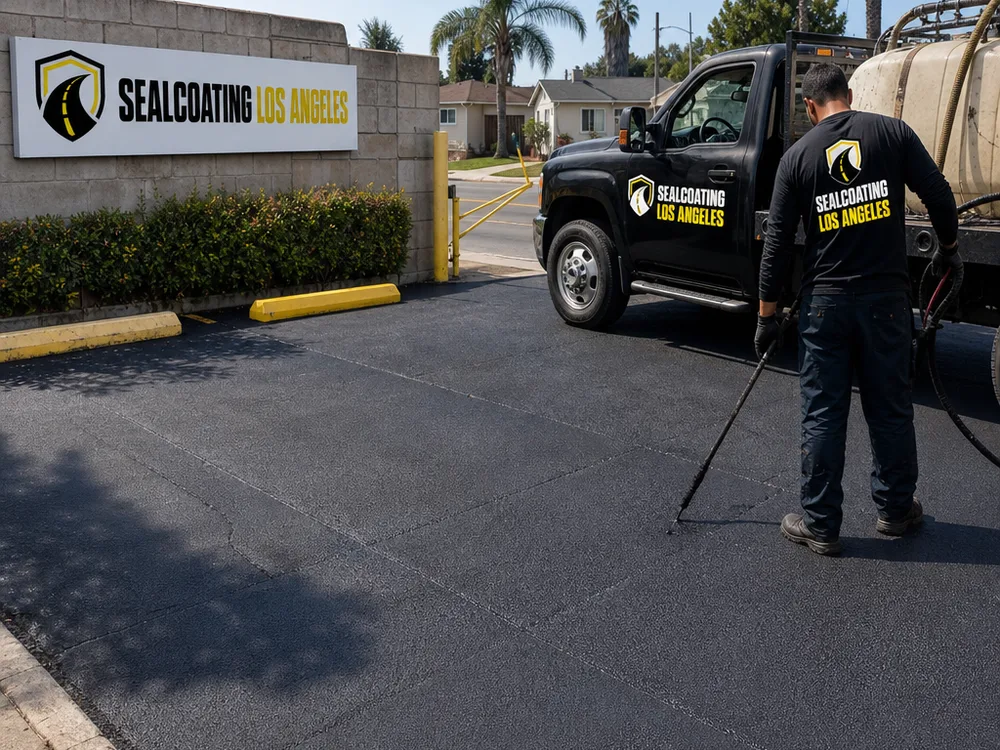
The questions that come up when a driveway runs uphill rather than sitting flat.
It takes more control, yes. Material naturally wants to move downhill while it is still wet, so the amount applied at once and the direction of work both have to account for that. The coating itself is the same product. What changes is the method, the time it takes, and the care needed at the top and bottom transitions.
Because that is where water ends up. Run-off follows the slope and concentrates at the lowest point, so the asphalt there spends far more time wet than the surface above it. Over the years that saturation works at the base and the edges, which is why deterioration on a sloped drive usually starts low.
No, and it is worth being direct about it. A crumbling edge has usually lost the support underneath it, and a coating adds no strength. Putting a finish over it produces a driveway that looks repaired for a season and then breaks away at the same point. The edge needs rebuilding first, and then coating makes sense.
In most cases yes, though steepness sets practical limits on method and on how much can be done in a session. We would rather look at the specific driveway than answer in the abstract, because the usable approach on a gentle rise and on a sharp one are not the same.
Barricades and markers, set up for the grade rather than dropped at the entrance. On a slope you also have to think about anything that could roll and about water crossing the surface if weather arrives. We agree the cure window with you and secure both ends.
It drains away faster, which helps, but it also travels with more force and ends up concentrated instead of spread out. That is why the low edge and the transitions take the wear. Fast drainage is only an advantage if the point where the water finally stops is properly sealed and supported.
If your sloped driveway is deteriorating at the bottom edge, have the grade and run-off assessed before any coating is scheduled.
Book Your Free InspectionDescribe the incline, where water collects, and what the edges look like at the lowest point. We will walk it, separate what needs rebuilding from what needs protecting, and set out the method in writing.
Request a quote
Send the surface, its size, and what you are seeing. We reply with next steps and a time for a walkthrough.